The climate crisis is not limited to environmental changes or the need to reduce emissions; rather, it is inextricably linked to production and consumption patterns, economic policies, the distribution of resources and wealth, and disparities in the capacities of various communities and groups to cope with its impacts and influence decisions related to them.
In Egypt, the impacts of climate change intersect with the challenges of water scarcity, pressures on agricultural production and food security, the conditions of workers and small-scale producers, and the nature of investments directed toward energy and infrastructure. Addressing these challenges requires examining the impact of climate policies on livelihoods and labor, on the rights of communities to water, land, and natural resources, and on the state’s capacity to provide public services. It also necessitates paying attention to disparities in women’s enjoyment of, ownership rights over, and control of resources, while recognizing their local and environmental knowledge and their role in resource management and food production.
In this context, the 2024 OECD Review of Green Policies in Egypt highlights the interlinked challenges of water scarcity, pressures on agriculture and natural resources, the need to develop
environmental information, enhance public participation, and address gaps in available international funding, particularly for adaptation. These challenges reveal the necessity of viewing climate policies as part of broader economic and social choices concerning resource distribution, rights protection, and the prioritization of investment and adaptation.
Furthermore, climate justice is inseparable from the impacts of wars and armed conflicts on the environment, natural resources, and living conditions, as well as the losses and damages they leave behind. These require responses that go beyond financial compensation to encompass full redress in all its forms, including rehabilitation, resource restoration, and guarantees of non-repetition. This calls for holding responsible parties accountable and ensuring the participation of affected communities in defining recovery and reconstruction priorities.
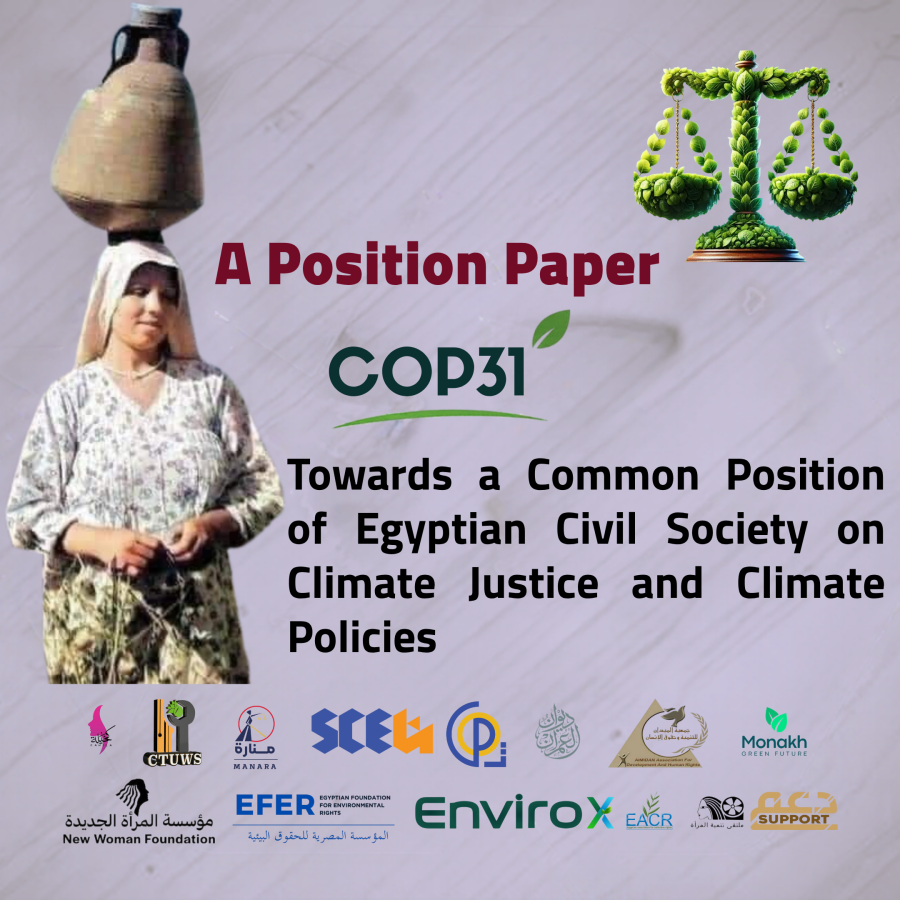
Accordingly, this paper builds upon consultative discussions that brought together a number of Egyptian civil society organizations in preparation for the 31st Conference of the Parties (COP31). It aims to crystallize common priorities for advocacy and action, identify issues requiring further research and coordination, and link national challenges and demands to international discussions on climate finance, a just transition, adaptation, loss and damage, and the right to information access, participation, and accountability.
Powered By EmbedPress