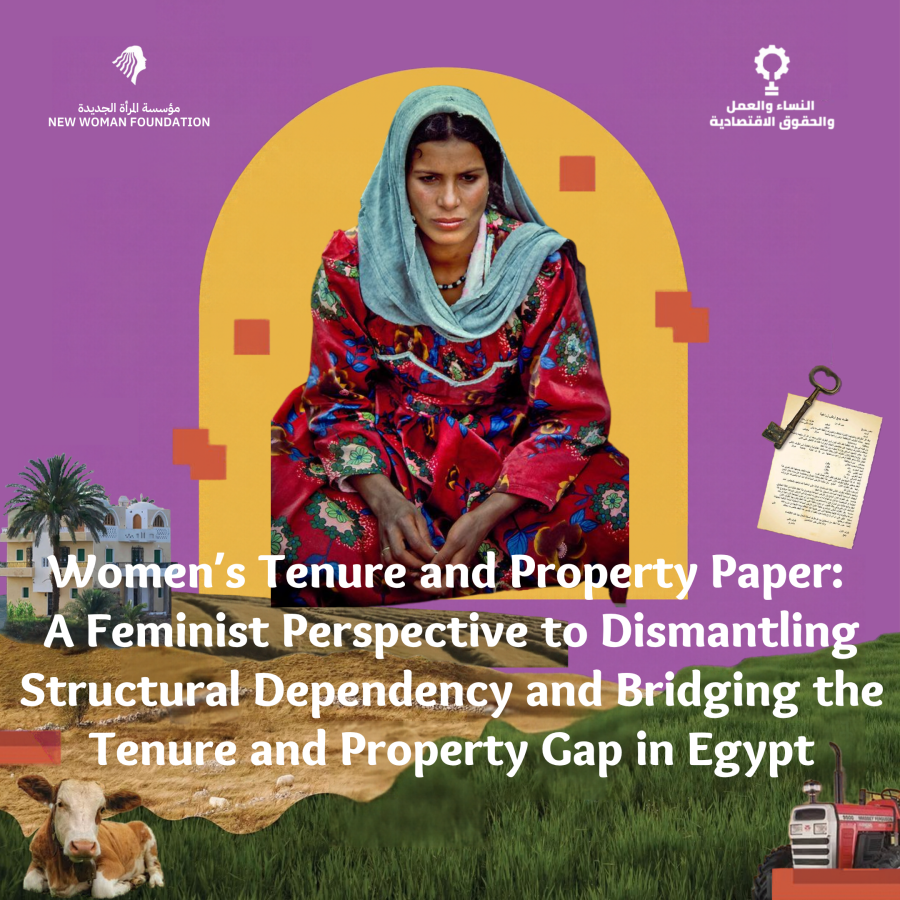
For rural women, land represents much more than a mere economic asset; it is a vital resource for production, income, and food, a source of economic and social security, and a key determinant of their decision-making power within the household and society. Consequently, a rural woman’s right to own, hold, use, and control the returns on land is directly linked to her economic and social rights, as well as her ability to combat poverty, vulnerability, and crises.
The reality of rural women in Egypt regarding property, tenure, and control over resources cannot be analyzed in isolation from the socio-cultural context within which women’s relationships with the family, work, and economic resources are shaped. From a feminist perspective, women’s lack of access to land and other productive assets is not merely a gap in legal implementation; rather, it must be understood as part of a broader socio-economic structure that reproduces unequal power relations between women and men, granting men—in many contexts—a more dominant position in owning, managing, and making decisions regarding resources.
While the law may recognize women’s rights to property and inheritance, the exercise of this right takes place within a society governed by unwritten rules, social expectations, entrenched gender roles, and familial and economic relations that render a woman’s ability to exercise her rights different from that of a man. Therefore, the existence of a right in legal texts does not necessarily imply that women possess the social, economic, and political capacity to exercise and defend that right. The Egyptian Constitution stipulates the achievement of equality between women and men in civil, political, economic, social, and cultural rights, and affirms the principles of equality and non-discrimination. Similarly, the legal framework recognizes women’s rights to property and inheritance, and Law No. 219 of 2017 introduced penalties for the intentional withholding of a legal heir’s rightful share or concealing inheritance documents.
It is worth noting here that feminist economics pushes us to move beyond a narrow concept of economic empowerment—which is often limited to training women or providing them with access to finance—toward a deeper concept linked to transforming the power relations that govern access to resources.
The question is not merely how to help women use available resources, but rather: Who owns the resources in the first place? Who determines the conditions of access to
them? Who controls their returns? Who bears the risks? And who holds the decision-making power?
The paper concludes that the primary challenge does not lie solely in the presence or absence of legal texts, but rather in rural women’s actual capacity to transform legal rights into real, secure, and sustainable rights regarding property, tenure, control, and economic benefit.
Powered By EmbedPress